UK learners: What to practise on motorways and dual carriageways
UK learners: What to practise on motorways and dual carriageways
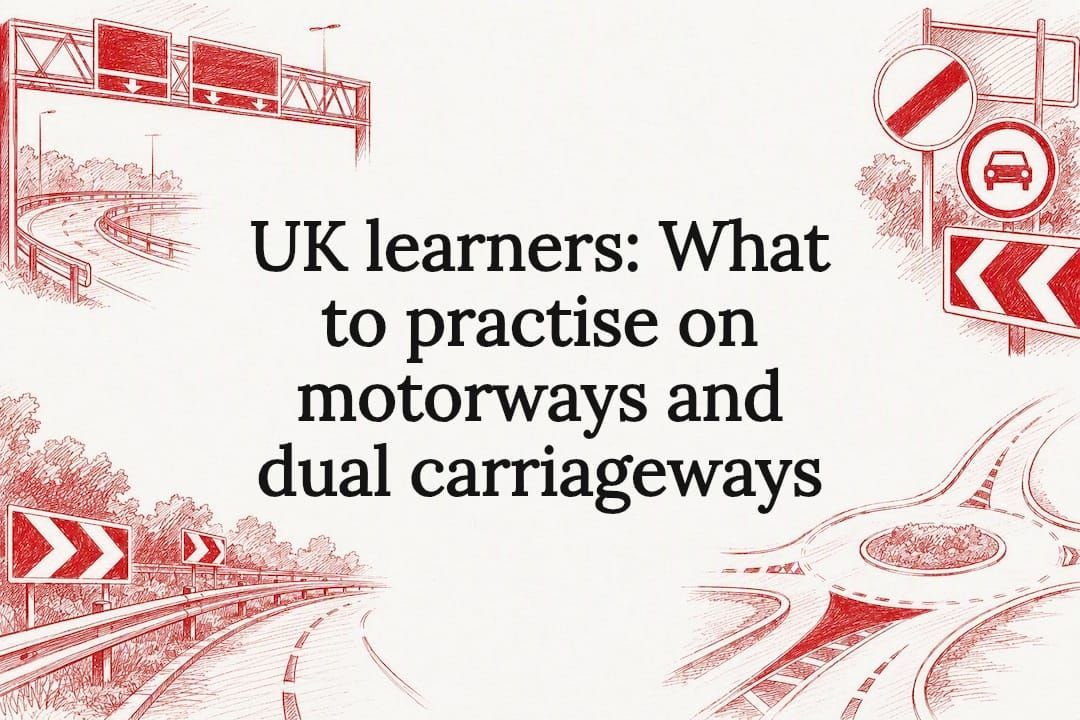
A motorway is a statutory road class marked by blue signs, "M" prefixes and controlled access via slip roads only. A dual carriageway is any road with a central reservation, which can include roundabouts, side roads and traffic lights. Both usually carry the national speed limit for cars, but learner access, vehicle restrictions and junction behaviour differ sharply, so lane discipline and instructor-led motorway practice matter more than the speed limit itself.
Key Points:
- Dual carriageways have a central reservation and can include roundabouts, traffic lights, and direct property access, unlike motorways which are fully controlled access roads.
- Speed limits for cars and motorcycles are generally 70 mph on both dual carriageways and motorways, but towing vehicles and heavy goods vehicles have lower limits on each.
- Motorways always require access via slip roads, prohibit pedestrians and cyclists, and have predictable geometry and higher speed standards, whereas dual carriageways have variable layouts and access points.
- Learning lane discipline, mirror checks, and gap judgement on dual carriageways lays the foundation for safe motorway driving, making staged practice essential before progressing.
- Supervised motorway lessons are recommended once learners are comfortable with dual carriageways, with structured courses like Pass Plus helping build confidence at higher speeds.
Table of Contents
- Dual carriageway vs motorway: what actually separates them?
- What officially makes a road a motorway?
- The differences that actually matter behind the wheel
- Dual carriageway speed limit UK: the figures that matter
- Driving safely on both road types: what to actually practise
- What professional lessons add before you face a motorway
- Why the order you learn things in matters more than people think
- Ready to build motorway confidence with a qualified instructor?
- Sources
- FAQ
Dual carriageway vs motorway: what actually separates them?
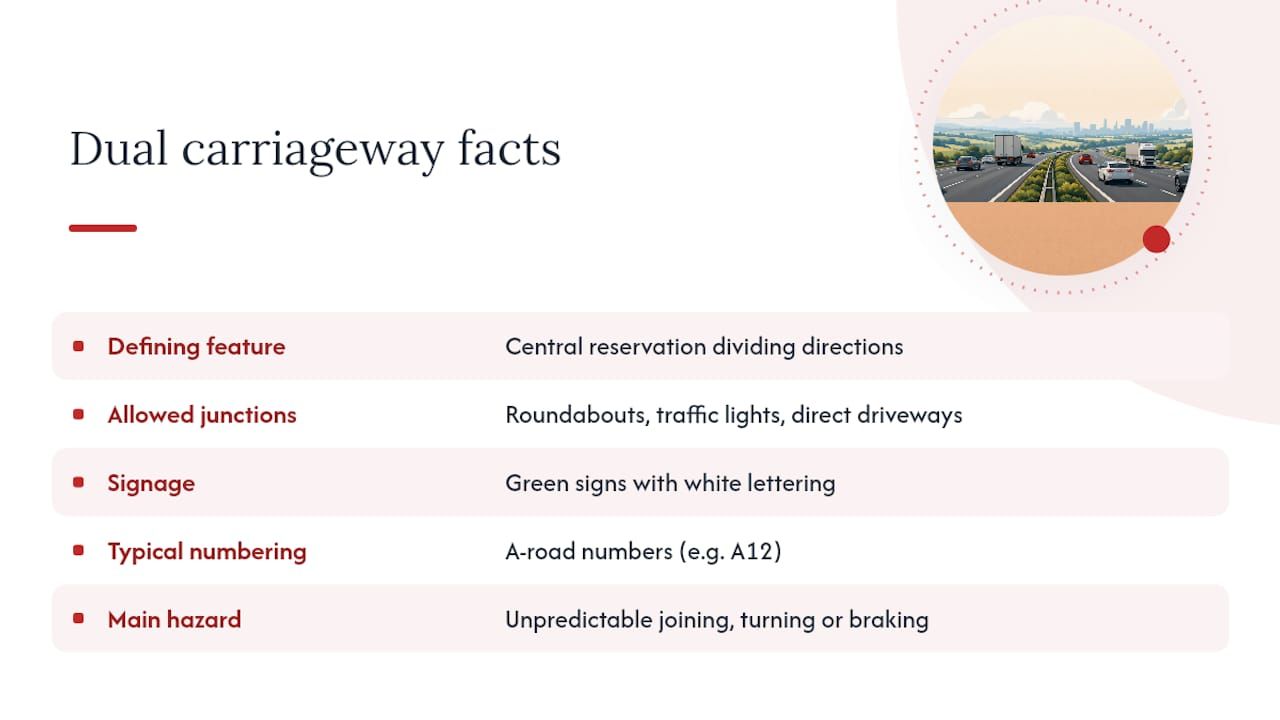
The confusion makes sense. Plenty of motorways are also dual carriageways, but not every dual carriageway is a motorway. The distinction is legal, not visual.
A dual carriageway is defined by one physical feature: a central reservation splitting traffic travelling in opposite directions, according to Carwow's breakdown of the two road types. That's it. It can still have roundabouts, traffic lights, pedestrian crossings, and direct driveways spilling out onto it. Signage tends to be green with white lettering, and roads carry an A-road number, like the A12 through Essex.
Lane discipline on a dual carriageway follows the same principle as anywhere else: keep left unless you're overtaking or turning right, then move back over once it's clear, per the Highway Code's general rules for all drivers. On a two-lane dual carriageway that sounds simple until a vehicle pulls out from a side road forty yards ahead while you're doing 65 mph in the outside lane.
That's the real hazard on dual carriageways: unpredictability. Vehicles join from the left, turn right across your path, or brake hard for a roundabout you didn't see coming because the signage was easy to miss. Multi-lane dual carriageways add another layer, since you're now managing overtaking manoeuvres across three lanes rather than two, with traffic merging from slip roads that behave more like ordinary junctions than a motorway on-ramp.
What officially makes a road a motorway?
A motorway isn't a description of how a road looks. It's a legal classification, signalled by blue backgrounds, white text and an "M" prefix, such as the M25 or M11. Access is controlled entirely through slip roads, and the Highway Code's motorway rules (253 to 274) make clear there are no roundabouts, no traffic lights, and no direct property access anywhere on the network.
That control changes the character of the driving. There's no pedestrian, cyclist or learner-moped traffic, no oncoming vehicles, and no junction where someone might suddenly cut across three lanes to turn right. Design standards are consistent too: predictable geometry, long acceleration and deceleration lanes at each junction, and (on many stretches) a hard shoulder for emergencies, though smart motorways have changed that in places.
Removing junctions and turning traffic removes several classic dual carriageway hazards. It replaces them with different ones. Speeds are higher and more consistent, which shrinks your reaction window. Lane-changing happens constantly as vehicles merge, overtake and exit, and the sheer volume of traffic moving at 70 mph demands tighter following distances than most learners have ever practised on an A-road.
The differences that actually matter behind the wheel
Sign colour is the fastest visual cue you'll get. Blue signs and an "M" number mean motorway rules apply immediately: no stopping, no reversing, no U-turns, and access strictly through a slip road. Green signs with an "A" number mean you're on a dual carriageway, where the rules are closer to ordinary road driving, just at higher speed and often with a physical barrier between you and oncoming traffic.
Beyond colour, a handful of practical differences decide how you should actually drive:
- Access : motorways only ever connect via slip roads; dual carriageways frequently have roundabouts, traffic lights and direct junctions at ground level.
- Vehicle and user restrictions : pedestrians, cyclists, horses, mopeds under 50cc and certain learner categories are barred from motorways; dual carriageways carry mixed traffic just like any other road.
- Learner access : you cannot drive unaccompanied or during your test on a motorway, but supervised motorway lessons with an ADI became permitted from June 2018, as confirmed by GOV.UK's announcement on learner motorway access.
- Design standards : motorways have consistent merge lengths and predictable geometry; dual carriageway layouts vary wildly from one stretch to the next, with tighter bends and shorter sightlines in places.
- Behaviour behind the wheel : overtaking on a motorway is a clean lane change and return; overtaking on a dual carriageway often means judging oncoming side-road traffic and roundabout approaches at the same time.
The Ready to Pass learner guidance on road types treats these as two distinct skill sets for good reason. Master one and you're only halfway prepared for the other.
Dual carriageway speed limit UK: the figures that matter
For cars and motorcycles, the national speed limit for cars and motorcycles applies on both dual carriageways and motorways, according to GOV.UK's speed limits guidance. That clarifies a common misconception that dual carriageways are limited to 60 mph for ordinary cars when in fact they usually share the higher national speed limit, unless signs indicate otherwise.
Other vehicle classes face lower ceilings on both road types:
| Vehicle type | Dual carriageway | Motorway |
|---|---|---|
| Cars and motorcycles | national speed limit | national speed limit |
| Cars towing a caravan or trailer | lower limits prescribed for towing vehicles | lower limits prescribed for towing vehicles |
| Buses and coaches (up to 12m) | lower limits apply | lower limits apply |
| Goods vehicles with weight limits | lower limits apply | lower limits apply |
| Heavy goods vehicles | lower limits apply | lower limits apply |
Pro Tip: Towing a caravan drops your limit to 60 mph on a road signed for 70 mph. Instructors see this catch learners out during Pass Plus sessions, so check the vehicle you're driving before assuming the blanket 70 mph limit applies.
Smart motorways and roadworks can override these figures with variable limits shown on overhead gantries. Those posted limits are legally binding, and ignoring a 50 mph gantry sign because "it's usually 70" is treated the same as speeding anywhere else.
Driving safely on both road types: what to actually practise
Speed alone doesn't make either road type dangerous. Poor anticipation does. Both road types reward the same underlying discipline: constant mirror checks, early planning, and never treating "keep left" as optional.
- Run the MSM/PSL routine every time you move : mirror, signal, manoeuvre, with a position, speed, look check before any overtake, whether that's pulling out on the A12 or changing lanes on the M25.
- Keep left unless overtaking , then return to the inside lane once you've cleared the vehicle, on both dual carriageways and motorways, as set out in the Highway Code's motorway rules.
- Match your speed on the slip road before you join , not after. Fifty miles an hour on a slip road feels noticeably faster than fifty on the main carriageway, and misjudging that gap is one of the most common learner errors instructors see.
- Scan further ahead on dual carriageways , because junctions, roundabouts and turning traffic can appear with little warning, unlike the closed system of a motorway.
- Treat variable speed limits and hard shoulder rules as binding , checking gantries continuously rather than assuming the national limit still applies.
The perception gap around slip roads deserves particular attention. Setting a target speed and repeating the join a few times with an instructor builds the muscle memory that a single lesson won't. Progressive exposure works best: quiet dual carriageways first, then a short, low-traffic motorway stretch, then busier sections once lane discipline is automatic rather than something you're consciously thinking through.
What professional lessons add before you face a motorway
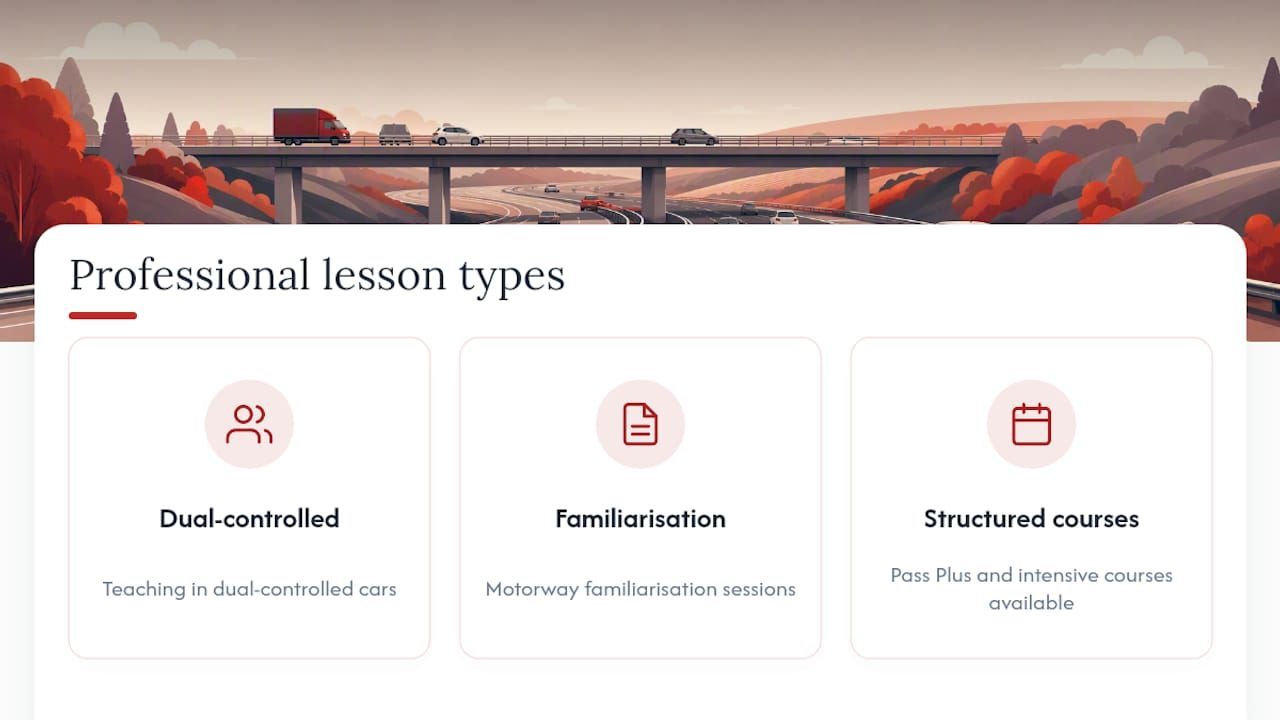
DVSA-approved instructors teach in dual-controlled cars, which matters most exactly when a learner needs a split-second correction at motorway speed. Motorway lessons are voluntary rather than compulsory, offered once an instructor judges a learner genuinely ready for the exposure, in line with the Ready to Pass guidance on motorway skills.
A staged approach into lesson structure includes motorway familiarisation sessions, Pass Plus for newly qualified drivers wanting structured motorway and night-driving practice, and intensive courses for learners working towards a test deadline. Each is designed around the same principle as the drills above, that confidence at higher speeds comes from repeated, supervised exposure, not from reading about it.
Why the order you learn things in matters more than people think
Most learners want the motorway lesson first, because it feels like the milestone that proves they've "made it." That's backwards. Lane discipline, mirror checks and gap judgement on a dual carriageway are the same skills a motorway demands, just at a pace that gives you time to think.
The anxiety around motorways is usually about speed, but the actual skill deficit is almost always spacing and lane discipline learned too late. Get comfortable on dual carriageways first, and the motorway becomes less of a leap and more of a continuation.
— Dean
Ready to build motorway confidence with a qualified instructor?
Reading the Highway Code tells you the rules. It doesn't put you on a slip road at rush hour with someone beside you who can correct a steering input before it becomes a problem. That's the gap a driving school can help close, with DVSA-approved instructors and dual-controlled vehicles.
Lessons can be built around staged progression such as:
- Motorway familiarisation sessions once your instructor judges you ready, practised in a dual-controlled car.
- Pass Plus courses covering motorway, night-time and higher-speed driving after you've passed your test.
- Intensive courses for learners working to a deadline, and other structured packages.
If you're preparing for your test or want to book a motorway familiarisation session, start with Costello's Driving School's lesson booking page, or work through the complete guide to passing your test for a fuller picture of what your test route might include. Learners outside Essex should also compare local provision, such as Connect Driving School's lesson pricing in London, to see how staged motorway preparation is taught elsewhere.
Sources
FAQ
Is a dual carriageway 60 or 70 mph?
Seventy miles an hour for cars and motorcycles, the same national limit that applies on motorways, according to GOV.UK's speed limits table. Vehicles towing a caravan or trailer are capped at 60 mph on both road types.
Is a dual carriageway considered a motorway?
No. A dual carriageway is defined by its central reservation and can include roundabouts and junctions; a motorway is a separate legal classification with controlled access and no at-grade junctions, as Carwow explains.
Is the A1 a dual carriageway or motorway?
The A1 is mostly a dual carriageway, though sections near Leeds and Newcastle have been upgraded to full motorway standard and signed accordingly. The road's letter and number prefix, "A" versus "M", tells you which stretch you're on.
Is it called a motorway in the UK?
Yes. "Motorway" is the official UK term for the statutory network of blue-signed, "M" prefixed roads with controlled slip-road access, distinct from dual carriageways, which can carry an A-road number.
Can learner drivers practise on motorways before their test?
Yes, since June 2018 learners have been permitted supervised motorway lessons with an approved driving instructor in a dual-controlled car, confirmed by GOV.UK's announcement on the rule change. These lessons are optional and don't form part of the practical test itself.
Recommended