20m & 6/12: Driving Test Eyesight Rules and Instructor Tips (UK)
20m & 6/12: Driving Test Eyesight Rules and Instructor Tips (UK)
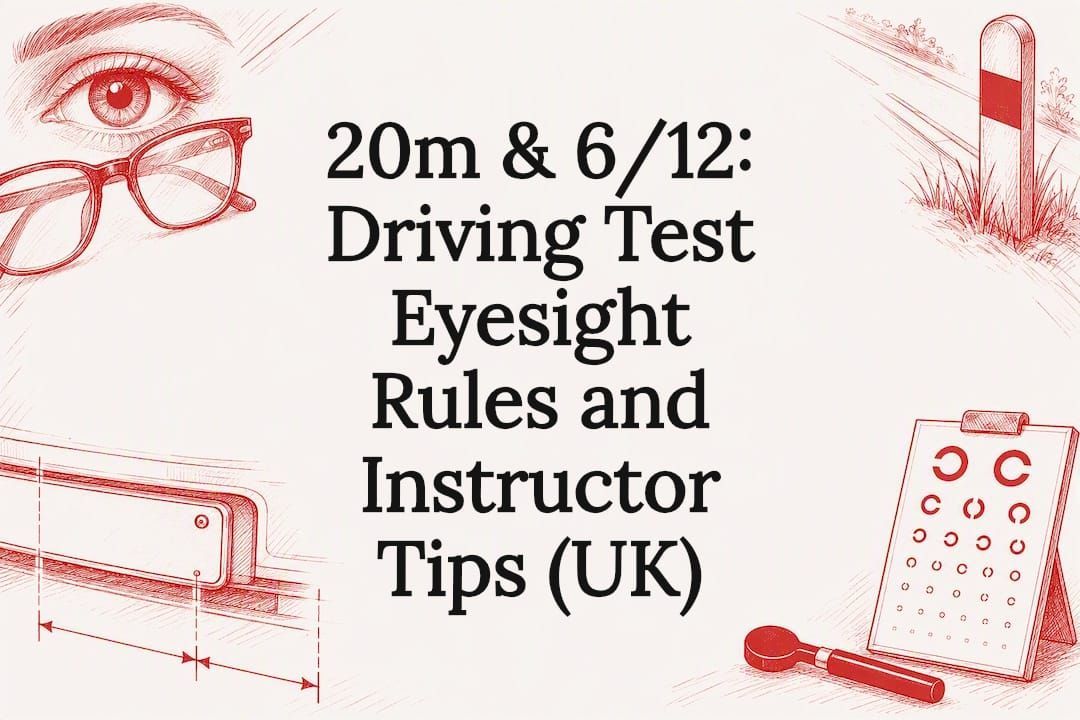
To pass the eyesight part of your driving test, you need to read a number plate from 20 metres away and have visual acuity of at least 6/12 on the decimal scale (0.5). Glasses or contact lenses are allowed, but you must wear them if that's what it takes to hit that standard. Fail the number-plate check and your test stops there and then, before you've even started the driving part. There's also a legal duty to tell the DVLA about certain eye conditions, which we'll come to shortly.
Key Points:
- The eyesight standard for driving in the UK requires reading a number plate from 20 metres and achieving a visual acuity of at least 6/12, with corrective lenses permitted if needed.
- Failing the number-plate check during the test results in an immediate failure and potential need for a retest before license approval; testing always includes the use of glasses or contacts if worn normally.
- Drivers over 70 currently self-declare their eyesight meets the standard during renewal, but a 2026 review may introduce mandatory testing at that age, emphasizing the importance of regular eye checks.
- Notifying the DVLA of certain eye conditions such as glaucoma or cataracts is mandatory, with failure to do so risking a fine and possible prosecution if vision-related incidents occur.
- Preparing by getting a professional eye test every two years, bringing spare glasses, and practicing reading number plates from 20 metres can help prevent failing the eyesight check on test day.
Table of Contents
- What are the legal eyesight standards for driving in the UK?
- What happens during the driving test eyesight check?
- When must you tell the DVLA about your eyesight?
- Do drivers over 70 face different eyesight rules?
- What should you do if you fail the eyesight check?
- How to prepare for your eyesight check before test day
- What driving instructors actually check for eyesight
- Why the eyesight check deserves more attention than it gets
- Book lessons that prepare you for every part of the test, not just the driving
- Sources
- FAQ
What are the legal eyesight standards for driving in the UK?
The number-plate rule is the one most learners have heard of, and it's straightforward: stand 20 metres from a vehicle and read its number plate. On new-style plates, that means two letters, two numbers, then three letters, with characters 79mm high and 50mm wide. If the vehicle carries an older-style plate, the distance is slightly longer, so examiners default to the 20-metre test with current plates to keep things consistent.
Behind that plate check sits a numeric standard: visual acuity of decimal 0.5, equivalent to 6/12 on the Snellen scale, measured with both eyes open together, or in your one good eye if you only have sight in one. The DVLA's INF188/1 guidance sets this out in detail, alongside the field-of-vision rule that often gets overlooked.
Field of vision matters just as much as sharpness. You need an adequate horizontal field with no significant gaps near the centre, and you shouldn't experience uncontrolled double vision. Someone with 20/20 acuity but a large blind spot from glaucoma can still fail to meet the standard.
Key points to remember:
- The 20-metre number-plate check is the practical, real-world proxy for the 6/12 acuity figure.
- Corrective lenses are permitted, but the DVLA does apply limits on lens power for certain categories of licence.
- Field-of-vision defects, not just blurred sight, can stop you meeting the legal standard even with perfect glasses.
What happens during the driving test eyesight check?
The eyesight check happens first, before you touch the controls. Here's the sequence:
- Your examiner walks you to a parked vehicle and asks you to read its number plate from roughly 20 metres.
- If you read it correctly, wearing glasses or contacts if you normally do, the test moves on to the driving part as normal.
- If you can't read it, the test ends immediately. It's recorded as a fail, and DVSA notifies the DVLA.
- A failed check can trigger a referral, meaning you may need a DVSA-administered number-plate retest before your licence entitlement is confirmed again.
On the practical side: bring your glasses or contacts to the test centre, not just to the car, and take a moment beforehand to check you can actually read a plate on the specific vehicle you'll be tested in.
When must you tell the DVLA about your eyesight?
Certain eye conditions carry a legal duty to notify the DVLA, regardless of whether you've noticed symptoms while driving. These include:
- Glaucoma affecting your field of vision
- Retinitis pigmentosa
- Uncontrolled double vision
- Significant sight loss in one or both eyes
- Cataracts that affect your acuity below the legal threshold
Once notified, the DVLA may fund further investigation and will accept eyesight tests from opticians only where they include an Esterman visual field test formatted to DVLA specifications. Without that, you may be asked to attend a DVLA-contracted provider instead.
Skipping this duty carries real risk: a fine of up to £1,000 for failing to report a notifiable condition, and if impaired vision contributes to a collision, you could face prosecution on top of that.
Do drivers over 70 face different eyesight rules?
Right now, anyone renewing a licence from age 70 does so every three years and simply self-declares that their eyesight meets the standard. No test is enforced by DVLA at that point unless something's already flagged your record.
That's under review. A 2026 government consultation is looking at mandatory eyesight testing for older drivers at the point of renewal, weighing up options on acuity checks, field-of-vision testing, and how often they'd be required.
Pro Tip: Don't wait for the consultation to conclude before getting your eyes checked. If you're over 70, book a test now, because deteriorating vision rarely announces itself before it becomes a problem behind the wheel.
Motoring bodies and charities have broadly welcomed the principle while pushing for a proportionate approach that doesn't unfairly restrict older drivers' independence. Some points worth flagging:
- Self-declaration currently relies entirely on honesty, with no independent check built in.
- The NHS offers free eye tests to some groups, including everyone aged 60 and over, regardless of any DVLA change.
- If mandatory testing is introduced, it's likely to be tied to the existing three-year renewal cycle rather than creating a separate appointment system.
What should you do if you fail the eyesight check?
Failing the number-plate check isn't the end of the road, but it does mean action on your part before you can drive again unsupervised.
- Book an optician appointment as soon as possible to establish your actual acuity and field of vision.
- If field loss is suspected, ask specifically for an Esterman visual field test, since that's what the DVLA typically requires for referrals.
- Follow whatever your optician or the DVLA instructs. In some cases that means further investigation before your entitlement is confirmed.
- Once you meet the standard again, you'll usually need to pass a DVSA number-plate retest to have your entitlement restored.
Continuing to drive while a referral is pending is a legal grey area at best, and it can invalidate your insurance if an insurer later discovers you knew your vision didn't meet the standard.
How to prepare for your eyesight check before test day
Get your eyes tested professionally at least every two years, longer gaps let gradual deterioration go unnoticed, since it's genuinely hard to judge your own vision slipping day by day. An optician will check acuity, field of vision, and glare sensitivity, which matters more than people realise for night driving and wet motorway conditions.
Before test day itself:
- Bring a spare pair of glasses or spare contact lenses if you rely on them.
- Clean your glasses properly, smudges and scratches can shave off just enough sharpness to fail the plate check.
- Practise reading a number plate at 20 metres in daylight beforehand, so you know it's genuinely achievable, not just theoretically possible.
- If your windscreen or car windows are grimy, that affects visibility too. A proper streak-free clean removes the kind of haze that dulls contrast in low light.
If you've been diagnosed with an eye condition, follow your clinician's advice to the letter, keep a written record of appointments and results, and notify the DVLA promptly where the condition is on the notifiable list.
What driving instructors actually check for eyesight
Every good lesson plan should include an early, informal number-plate check, not as a gotcha, but so learners find out well before test day whether there's a genuine issue to sort out. Instructors build this into early lessons rather than leaving it as a surprise on the test itself.
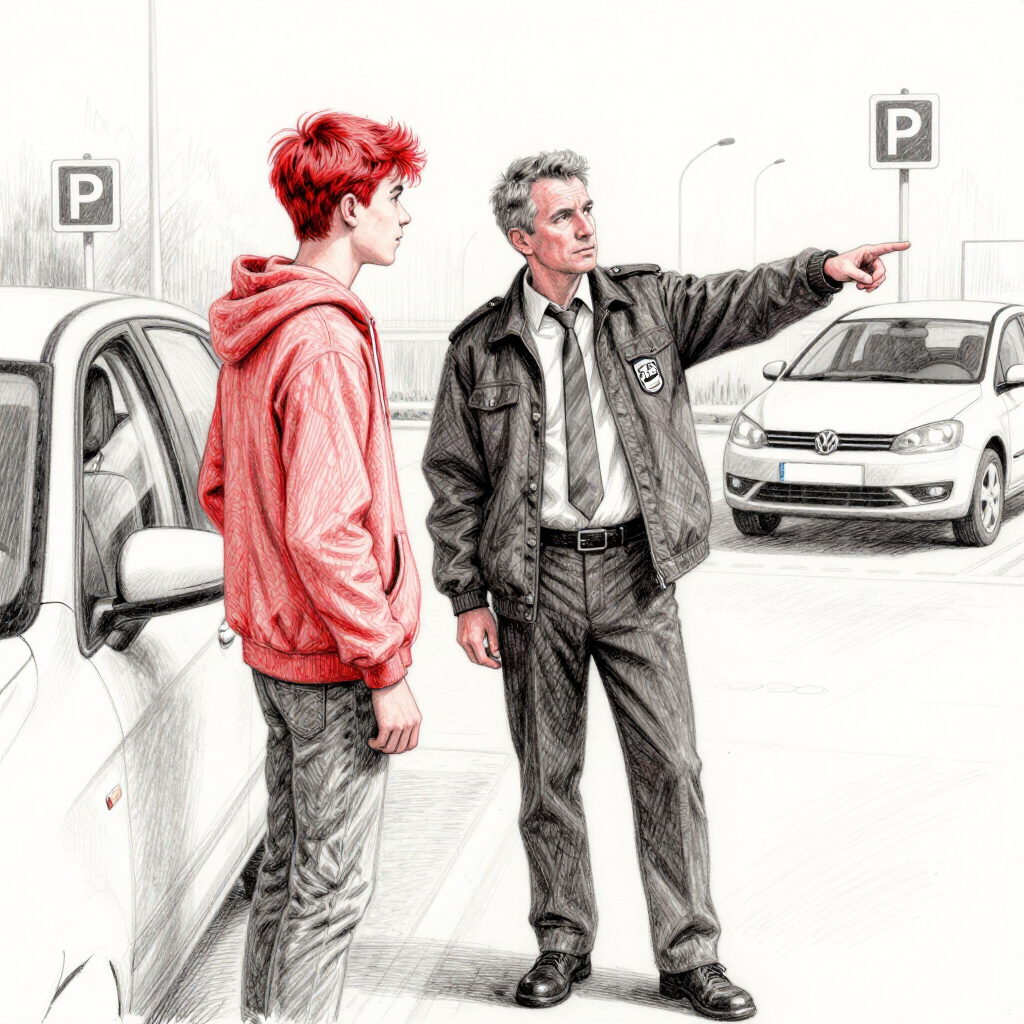
For learners who wear glasses or contacts, or who sit close to the borderline on acuity, instructors adjust lesson pacing to include mock eyesight checks and extra low-light practice, since glare and dusk conditions expose weaknesses that a daytime check alone won't catch. With many years of teaching experience and DVSA-approved instructors, that kind of early flag has saved many learners an avoidable test-day fail. The Guaranteed Pass packages build in this groundwork as standard, not as an afterthought.
Why the eyesight check deserves more attention than it gets
Most learners treat the eyesight check as a formality, something to get through before the real test starts. That's the wrong instinct. It's the single most binary pass or fail moment in the entire process. There's no partial credit, no "minor fault" category, no room to recover once the examiner has heard "I can't read it."
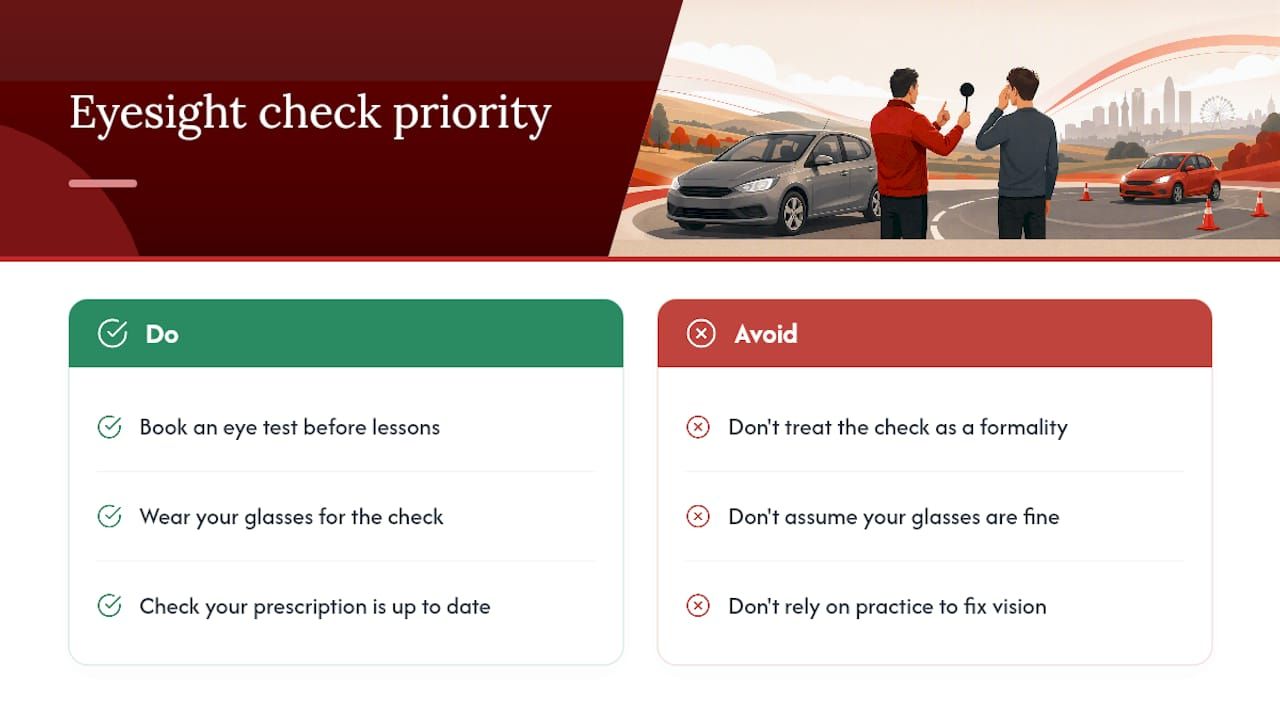
The conventional advice, "just wear your glasses," undersells how many people genuinely don't know their current prescription is out of date. Vision drifts gradually enough that you adapt without noticing, right up until you're stood 20 metres from a number plate with an examiner watching.
If there's one priority worth acting on before anything else in test preparation, it's this: book an eye test before you book more lessons. It costs less, takes less time, and removes a failure mode that has nothing to do with your driving ability. Everything else, the reversing, the roundabouts, the parallel parking, can be practised and improved. A vision problem you don't know about can't be practised away.
— Dean
Book lessons that prepare you for every part of the test, not just the driving
A professional driving instructor offers something a generic online guide can't: someone sitting next to you who flags a vision or confidence issue early in lessons, not on test day. Instructors build a quick number-plate check into early lessons, so nothing catches you out when it actually counts.
Whether you're just starting out or need a confidence boost after a previous fail, our driving lessons are tailored around what you actually need, including support for learners with ADHD or other additional needs. If you want the highest level of test-day preparation, including mock tests that mirror the real eyesight check, the Guaranteed Pass course bundles that support into one structured package. Get in touch today to book your first lesson and find out where you stand.
Sources
FAQ
What is the eyesight limit for driving in the UK?
You need to read a number plate from 20 metres and have visual acuity of at least decimal 0.5 (6/12 on the Snellen scale), with glasses or contact lenses allowed if needed.
What happens if you fail the 20m eyesight check on your driving test?
The test ends immediately and is recorded as a fail; you may need to pass a DVSA number-plate retest before your licence entitlement is confirmed again.
What are the new eyesight rules for DVLA?
A 2026 government consultation is examining mandatory eyesight testing for drivers aged 70+ at licence renewal, covering options for acuity checks, field-of-vision testing, and frequency.
What is the DVLA eyesight test for driving in the UK?
It combines the 20-metre number-plate check used in the practical test with the wider legal standard of 6/12 visual acuity and an adequate field of vision, as set out in DVLA's INF188/1 guidance.
Do I need glasses for my driving test if I don't normally wear them for everyday tasks?
If you can meet the 6/12 acuity standard and read the number plate at 20 metres unaided, you don't need glasses, but if you need them to reach that standard, you must wear them for both the test and every time you drive.
Recommended